
Bioinformatics Core Facility (BCF)
The Bioinformatics Core Facility (BCF) primarily provides computational support for investigators at UT Health San Antonio but also provides services to administrative and departmental offices on campus. The BCF supports a wide range of scientific applications, software packages, and computing platforms, with an emphasis on Unix/Linux/X11 architectures. The BCF offers assistance gaining access to national resources like XSEDE and TeraGrid, and provides programming services for websites, database applications and custom scientific software. Our programmers are well versed in numerous programming languages, including C/C++, Java, php, MySQL, and shell programming. We assist with backup solutions for your laboratory, high performance parallel and supercomputing applications, visualization, and next-generation sequence analysis, and specialize in the implementation of demanding network solutions for your laboratory and workplace. We also offer poster printing services for formats up to 42 inches in height (arbitrary width).
By integrating high-performance computing into current research, we hope to facilitate leading-edge research and help investigators at UT Health San Antonio to be computationally competitive in a broad spectrum of research applications. The facility is equipped with a modern 230 processor supercomputer for parallel computation and offers mass storage for database and data mining application. We further support popular bioinformatics and genomics software packages, including next-generation sequence analysis. Trained staff are available to address security, programming, web development, and other computational tasks, and to help you with your custom programming needs. Our goal is to foster collaborations and provide assistance with grant writing for proposals seeking to integrate modern computational techniques in research activities.
Our mission is to provide services in the following areas:
- Services to Researchers:
-
- Consultation – support for investigators with questions regarding data acquisition, data management and data analysis. These services are free of charge during the grant-writing phase of a project.
- Data storage and analysis – a supercomputer and mass storage are available to store and analyze large data sets.
- Unix server software support – scientific software packages requiring Unix platforms in order to function are supported for installation and maintenance.
- Design and programming of custom software (e.g., data analysis software, statistical applications, image processing, and web-based client/server interfaces).
- Network interfacing – access to a firewall-secured data network with direct access to the beowulf supercomputers, a database server, and other Unix data services (web server, mail server, X-Windows access, mailing lists etc.).
- General software support – multiple licenses of commonly used software have been purchased and are available to Health Science Center researchers.
 Molecular Structure Modeling through BCF:
 BCF Projects
NMR Core Director
|
LocationAllied Health Bldg Room 5.206 ContactsGary Gorbet |
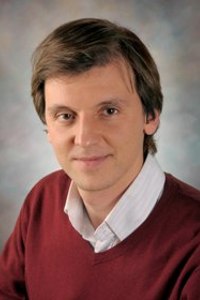 Dr. Borries Demeler, Associate Professor